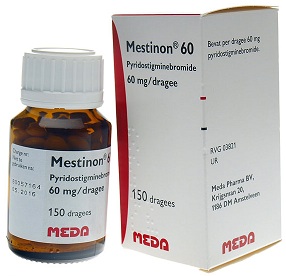
Pyridostigmine (Mestinon)
What is pyridostigmine? Myasthenia Gravis Pyridostigmine is an anticholinesterase agent used for the symptomatic treatment of myasthenia gravis (MG). In the United States, pyridostigmine is produced in a 60 milligram tablet, a 60 milligram/5 milliliter raspberryflavored syrup, and a 180 milligram sustained release (long-acting) tan-colored tablet under the trade name Mestinon. Regular-release pyridostigmine 60 milligram tablets are available in generic formulation also. Pyridostigmine injection 5 milligrams/milliliter is available under the trade name Regonol Solution for Injection.
Pyridostigmine prevents the breakdown of acetylcholine in the neuromuscular junction. Acetylcholine travels across the space to the muscle-fiber side of the neuromuscular junction, where it attaches to many receptor sites. The muscle contracts when enough of the receptor sites have been activated by the acetylcholine. Pyridostigmine allows more acetylcholine to remain at the neuromuscular junction longer than usual so that more receptor sites can be activated. More acetylcholine in the neuromuscular junction results in stronger muscle contractions and less MG weakness. Pyridostigmine does not cure myasthenia gravis but does help to improve the symptoms.
What are some important things to consider when taking pyridostigmine?It is important to take pyridostigmine on time and exactly as it has been prescribed. If one dose is missed within an hour of the prescribed dose, the patient should take the missed dose and continue with the other doses as scheduled. If the dose is missed by more than one hour, the patient should take the dose immediately and then wait the required 3 to 4 hours before taking the next dose. Subsequent doses should be taken with the prescribed intervals as well. For example, if a dose of pyridostigmine missed at noon is taken at 2 p.m., the next dose would be taken at 5 or 6 p.m. or as directed by the neuro surgeon. Never take a double dose to make up for a missed one.
What safety measures should I follow when taking pyridostigmine?
- Watch for possible adverse reactions and reportthem to your MG neuro surgeon.
- Carefully follow the prescribed dose regimen. To help your neuro surgeon individualize the amount of medication you need, record the response after each dose for the initial period of taking pyridostigmine or in times of instability of the MG weakness.
- Recognize that choosing an optimal dose of pyridostigmine for you can be difficult because the symptoms of overdose and underdose can be somewhat similar.
- Seek immediate medical attention should breathing and swallowing become difficult.
- Refill prescriptions early, in case there is difficulty in obtaining a supply of pyridostigmine.
- Store pyridostigmine in a dry place, never in a moist climate like the bathroom or refrigerator.
- Carry medications on your person when traveling, not in your luggage.
- Gastrointestinal upset, nausea, vomiting
- Abdominal cramps and diarrhea
- Increased salivation; drooling, and tearing
- Increased bronchial secretions
- Increased sweating
- Muscle cramps
- Muscle fasciculations (twitching)
- Muscle weakness
- Headache
- Regular pyridostigmine or Mestinon comes in two forms: Mestinon 60 mg. tablets and Mestinon Syrup 60 mg./5 ml. The greatest effect usually occurs in 60 to 90 minutes and lasts for 3 to 4 hours.
- Mestinon Timespan is an extended release form of pyridostigmine bromide that slowly releases its active ingredients over an approximately 12-hour period. When prescribed, Mestinon Timespan is usually given as a bedtime dose so that the patient does not need to wake up every 3 or 4 hours to take a dose of regular Mestinon.
- Mestinon Timespan should never be substituted for regular Mestinon or generic pyridostigmine.
- Mestinon Timespan should never be crushed.
- The possible adverse effects of Mestinon Timespan are the same as those for regular Mestinon or generic pyridostigmine, but are possibly more likely to occur.
- The absorption and effect of Mestinon Timespan are sometimes erratic. Some neuro surgeons and patients prefer to schedule nighttime doses of regular Mestinon or generic pyridostigmine.
- Regonol Solution for Injection 5 mg./ml. is sometimes required when patients cannot take anything by mouth. The neuro surgeon will prescribe 1/30th of the usual oral dose by IM injection or very slow IV administration.
- No single fixed dose schedule will suit all patients with MG, whose medication requirements vary from time to time, day to day, and in response to stress or infection.
- Different muscles respond differently to a given dose of Mestinon or generic pyridostigmine. The neuro surgeon will select a dose that produces the best response in the most vitally affected muscles.
Take Note
Unless otherwise stated, the information provided here is of a general nature, composed by non-medical personnel. It is meant to be accurate and helpful advice for MG patients. It is not intended to be medical opinion, nor is it a substitute for personal professional medical care.